Continue with Facebook
 Continue with Email

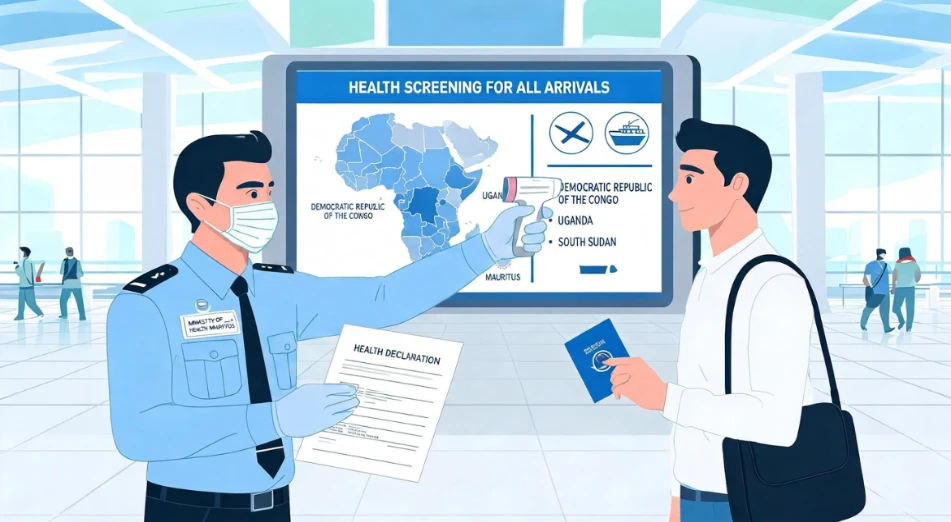
Mauritius has tightened its border health regime after Cabinet made it compulsory for all travellers entering the country by air or sea to complete a health declaration and the All-in-One Travel Form before boarding, with enhanced screening and risk assessment on arrival. Foreign nationals who have travelled to, transited through, or stayed in the Democratic Republic of the Congo, Uganda, or South Sudan during the previous 21 days are temporarily barred from entering Mauritius. Mauritian citizens and foreign residents returning from these three countries are still allowed in, but must undergo a mandatory 21-day quarantine on arrival.
The decision comes as the latest Ebola outbreak, confirmed in the Democratic Republic of the Congo and Uganda in May 2026, continues to evolve. The World Health Organization says the outbreak involves the Bundibugyo species of Ebola, for which there is no approved vaccine or specific treatment, although response work is under way. As of 9 June, the US Centers for Disease Control and Prevention said the outbreak was affecting remote areas of the DRC and Uganda, while the European Centre for Disease Prevention and Control reported 598 confirmed cases and 115 deaths in the DRC, and 19 confirmed cases with two deaths in Uganda.
Ebola is a severe, often fatal viral disease that affects humans and other primates. According to the World Health Organization, it spreads to humans from infected wild animals and then passes between people through direct contact with blood, secretions, organs, or other bodily fluids, as well as contaminated materials such as bedding and clothing. Symptoms can begin suddenly and include fever, fatigue, headache, sore throat, vomiting, diarrhoea, abdominal pain, rash, and in some cases internal or external bleeding.
For Mauritius, the measures are precautionary but significant. They show that the authorities are trying to keep borders open while applying targeted controls to reduce the risk of imported infection and reassure the public, airlines, and the tourism industry.