Continue with Facebook
 Continue with Email


Two bills now before Parliament, the Finance Bill No. XII of 2026 and the Economic and Financial Measures Bill No. XIII of 2026, change who pays extra tax on State land homes, tighten the rules around EDB property schemes, and create a golden visa that residential property purchases cannot buy. Find yourself in the table below, then read the section written for you.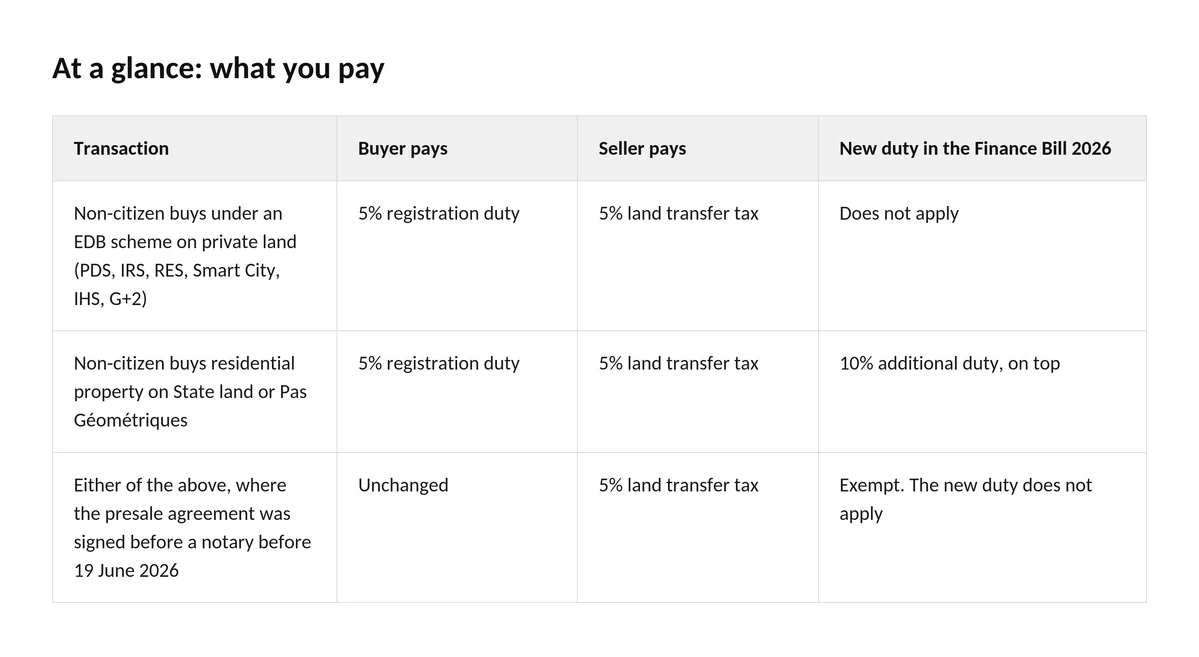
The 5 percent registration duty and the 5 percent land transfer tax apply to non-citizen EDB-scheme acquisitions under the bills as tabled. Finance Bill 2026 reverses the 1 July 2026 doubling and restores the previous 5 percent rate on each. What is new is the third column: an additional 10 percent on certain State land residential transfers, paid by the seller.
What this means for foreign homebuyers
If you are buying under an EDB scheme, you pay 5 percent registration duty on the purchase price.
The seller's bill may have increased
If the property sits on State land or on Pas Géométriques, the Finance Bill adds a further 10 percent duty payable by the seller, on top of the 5 percent land transfer tax they already owe. Expect that to show up somewhere in the price.
The duty applies where a residential property on State land or Pas Géométriques is transferred to a non-citizen under section 3(3)(c)(v) of the Non-Citizens Property Restriction Act. The rate is set through a new Part IV of the Seventh Schedule of the Land Duties and Taxes Act.
The date on your presale agreement now matters as much as the price
The new duty does not apply where both of these are true: the parties signed a presale agreement before 19 June 2026, and that agreement was drawn up and signed before a notary.
The bill defines presale agreement precisely. In a VEFA, an off-plan sale, it is a contrat de réservation préliminaire under Article 1601-38. In every other case it is a promesse de vente under Article 1589, a preliminary contract in which seller and buyer agree to sell and buy subject to conditions, executed before a notary.
If your reservation contract or promesse de vente meets both tests, the new 10 percent should not apply to your transaction. The underlying 5 percent registration duty and 5 percent land transfer tax still apply. Ask your notary to confirm the exemption in writing before you complete, because the safe harbour turns on both the date of signature and the form of the agreement.
Your villa will not get you a golden visa
Buying under an EDB scheme can give you residency rights linked to that property. It cannot give you a golden visa. The First Schedule of the EDB Act requires an aggregate investment of USD 1 million in any business activity other than the acquisition of a residential property under the EDB property schemes. Your purchase is expressly excluded from that figure.
Two smaller things worth checking
Ask your lawyer whether electronic registration has been initiated on the Registrar-General's portal. The Economic and Financial Measures Bill inserts Article 2110-1 into the Civil Code, disapplying the general rule in Article 2110 on when the buyer carries risk in those cases. It affects who bears the loss if something goes wrong between signature and registration.
If you are buying in a flood-prone or low-lying area, the same bill tightens drainage oversight, requiring closer coordination between the Land Drainage Authority, the National Development Unit and other agencies. Better standards on new projects, and stricter requirements for the developer building yours.
What this means for sellers and developers
If you are selling a home to a non-citizen
You pay the 5 percent land transfer tax.
If the property is residential and sits on State land or Pas Géométriques, the Finance Bill adds a further 10 percent additional duty. It is payable by the transferor, meaning seller. Your combined exposure on such a sale is therefore the standard 5 percent land transfer tax plus this new 10 percent duty.
The exemption is your single most valuable document. If a presale agreement was signed before a notary before 19 June 2026, the new duty does not apply. Find those agreements, check the dates, check they were executed before a notary rather than privately, and have your notary confirm the position in writing.
If you are a developer or promoter
The drainage clause is the one to plan around. The National Development Unit must now prioritise and implement recommended drainage infrastructure projects and allocate them to local authorities, the Road Development Authority or specialised companies. Tighter control should improve what gets built. It also gives you a stricter standard to meet, and projects that fall short of it can expect delays.
Your paperwork costs go up. The Finance Bill raises some land surveyor fees for memoranda and valuations, for example from Rs 200 to Rs 300 per lot, and from Rs 2,000 to Rs 5,000 in certain cases.
One channel closes. The bills delete the Integrated Modern Agricultural Morcellement Scheme and Certificate from the Economic Development Board Act. No new projects can use that agricultural property route. Whether projects already in the pipeline are protected is not addressed in the bills as tabled, and it is the question to put to your adviser if you are affected.
Attorneys can now do work that was reserved to notaries. The Finance Bill adds attorney-at-law alongside notary in the Registration Duty Act and the Transcription and Mortgage Act, widening who may handle certain formalities. That matters as electronic registration expands.
If you are an estate agent
The Real Estate Agent Authority is listed as a statutory body over the Real Estate Sector. The REEA issued a communiqué a few days ago, calling all real estate agencies to register with them within the next three months.
The certificate is a legal requirement. It is also a sales tool. Once the register is public, a foreign investor can check an agent before the first meeting rather than after the first payment, and agents who have registered will want that checked.
More on the Real Estate Agent Authority's Communiqué here.
What this means for tech entrepreneurs and business investors
The golden visa is now defined, and property will not buy it
The bills introduce the golden visa as a defined concept in both the EDB Act and the Income Tax Act. It is a visa issued under the Passports Act on the recommendation of the Economic Development Board, aimed at substantial investors rather than holiday home buyers.
To qualify an applicant must hold a golden visa and must have invested an aggregate of USD 1 million, or the equivalent, in any business activity other than the acquisition of a residential property under the EDB property schemes.
That exclusion is the whole point of the clause. Money spent on an EDB residential property does not count towards the million. Property-based residency and the golden visa are now two separate routes. Buying a home puts you on the first. Only business investment puts you on the second. If you were planning to combine a villa purchase with a visa application, that structure no longer works.
The AI City Scheme, and what is still unknown
The Economic and Financial Measures Bill adds an AI City Scheme to the EDB Act. It belongs in a property guide because the certificate carries property rights with it.
The scheme is designed as a dedicated zone for artificial intelligence, digital sectors, advanced computing and advanced manufacturing. A person or an AI founder can apply to the EDB for an AI City Scheme Certificate. A certificate holder can then obtain tax and non-tax incentives, duty exemptions and concessions with the detail to be set by regulations, fast-tracked occupation, work and residence permits, and such acquisition or lease of immovable property as may be prescribed.
The property rights attached to the certificate are not defined. The bill leaves them to regulations that have not been published, so the shape of the scheme, including where the zone sits and what may be bought or leased, is still open.
What is clear is the intent. This is a business premises track, not a residential one. Buying a villa in an EDB scheme has nothing to do with AI City. If your company holds an AI City certificate, you may gain prescribed rights to buy or lease property in the zone, together with the incentives and permits above.
Reference: what each bill actually does
Finance Bill No. XII of 2026.
Creates the additional 10 percent duty on residential property on State land or Pas Géométriques transferred to a non-citizen, payable by the transferor, with the exemption for presale agreements signed before a notary before 19 June 2026. Adds attorney-at-law alongside notary in the Registration Duty Act and the Transcription and Mortgage Act. Raises certain land surveyor fees. Brings the Real Estate Agent Authority into the statutory bodies framework. Reverses the 1 July 2026 doubling of registration duty and land transfer tax for non-citizens under EDB schemes, restoring the standard 5 percent rate.
Economic and Financial Measures Bill No. XIII of 2026.
Introduces the golden visa in the EDB Act and the Income Tax Act, excluding EDB residential purchases from the USD 1 million threshold. Creates the AI City Scheme, with property rights to be prescribed by regulation. Deletes the Integrated Modern Agricultural Morcellement Scheme and Certificate. Inserts Article 2110-1 into the Civil Code on risk and electronic registration. Amends the Land Drainage Authority Act to tighten coordination on drainage.
Read together, the direction is consistent. Tax pressure on foreign-buyer transactions changes shape rather than simply rising across the board. Residency through property and residency through business investment are pulled apart and no longer overlap. Drainage, registration and agent regulation all move towards tighter control.
This guide covers the bills as tabled. Provisions can change before the enactment of the Finance Bill 2026, and the AI City property rights depend on regulations not yet published. Confirm your position with your notary or tax adviser before you sign.